Pages

Sunday, December 14, 2014

'Twas a Florida Christmas


twas a florida christmas

'Twas the night before Christmas and all through the town,

no noses were frozen, no snow fluttered down,

no children in flannels were tucked into bed,

they all wore shorty pajamas instead.
To find wreaths of holly, 'twas not very hard,

for holly trees grew in every back yard.

In front of the houses, Dads and Moms were

adorning the bushes and coconut palms.
The sleeping kiddies were dreaming in glee,

hoping to find water skis under the tree.

They all knew that Santa was well on his way,

in a Mercedes-Benz, instead of a sleigh.
And soon he arrived and started to work,

he hadn't a second to linger or shirk.

He whizzed up the highways and zoomed up the road,

in a S-L 300, delivering his loads.
The tropical moon gave the city a glow,

and lighted the way for old Santa below.

As he jumped from the auto he gave a wee chuckle,

he was dressed in Bermudas with an Ivy league buckle.
There weren't any chimneys, but that caused no gloom,

for Santa came in through the Florida room.

He stopped at each house... stayed only a minute,

emptying his sack of stuff that was in it.
Before he departed, he treated himself

to a glass of papaya juice upon the shelf.

He turned with a jerk and bounced to the car,
remembering he still had to go very far.
He shifted the gears and stepped on the gas

and up Highway 436 he went like a flash.

And I heard him exclaim as he went on his way,

"MERRY CHRISTMAS Y'ALL, I WISH I COULD STAY!"
http://www.inspire21.com/stories/holidaystories/TwasaFloridaChristmas

Monday, December 8, 2014

Christmas; or, The Good Fairy by Harriet Beecher Stowe


Christmas; or, The Good Fairy

by 


"O, dear! Christmas is coming in a fortnight, and I have got to think up presents for every body!" said young Ellen Stuart, as she leaned languidly back in her chair. "Dear me, it's so tedious! Every body has got every thing that can be thought of."
"O, no," said her confidential adviser, Miss Lester, in a soothing tone. "You have means of buying every thing you can fancy; and when every shop and store is glittering with all manner of splendors, you cannot surely be at a loss."
"Well, now, just listen. To begin with, there's mamma. What can I get for her? I have thought of ever so many things. She has three card cases, four gold thimbles, two or three gold chains, two writing desks of different patterns; and then as to rings, brooches, boxes, and all other things, I should think she might be sick of the sight of them. I am sure I am," said she, languidly gazing on her white and jewelled fingers.
This view of the case seemed rather puzzling to the adviser, and there was silence for a few moments, when Ellen, yawning, resumed:--
"And then there's Cousins Jane and Mary; I suppose they will be coming down on me with a whole load of presents; and Mrs. B. will send me something--she did last year; and then there's Cousins William and Tom--I must get them something; and I would like to do it well enough, if I only knew what to get."
"Well," said Eleanor's aunt, who had been sitting quietly rattling her knitting needles during this speech, "it's a pity that you had not such a subject to practise on as I was when I was a girl. Presents did not fly about in those days as they do now. I remember, when I was ten years old, my father gave me a most marvellously ugly sugar dog for a Christmas gift, and I was perfectly delighted with it, the very idea of a present was so new to us."
"Dear aunt, how delighted I should be if I had any such fresh, unsophisticated body to get presents for! But to get and get for people that have more than they know what to do with now; to add pictures, books, and gilding when the centre tables are loaded with them now, and rings and jewels when they are a perfect drug! I wish myself that I were not sick, and sated, and tired with having every thing in the world given me."
"Well, Eleanor," said her aunt, "if you really do want unsophisticated subjects to practise on, I can put you in the way of it. I can show you more than one family to whom you might seem to be a very good fairy, and where such gifts as you could give with all ease would seem like a magic dream."
"Why, that would really be worth while, aunt."
"Look over in that back alley," said her aunt. "You see those buildings?"
"That miserable row of shanties? Yes."
"Well, I have several acquaintances there who have never been tired of Christmas gifts, or gifts of any other kind. I assure you, you could make quite a sensation over there."
"Well, who is there? Let us know."
"Do you remember Owen, that used to make your shoes?"
"Yes, I remember something about him."
"Well, he has fallen into a consumption, and cannot work any more; and he, and his wife, and three little children live in one of the rooms."
"How do they get along?"
"His wife takes in sewing sometimes, and sometimes goes out washing. Poor Owen! I was over there yesterday; he looks thin and wasted, and his wife was saying that he was parched with constant fever, and had very little appetite. She had, with great self-denial, and by restricting herself almost of necessary food, got him two or three oranges; and the poor fellow seemed so eager after them!"
"Poor fellow!" said Eleanor, involuntarily.
"Now," said her aunt, "suppose Owen's wife should get up on Christmas morning and find at the door a couple of dozen of oranges, and some of those nice white grapes, such as you had at your party last week; don't you think it would make a sensation?"
"Why, yes, I think very likely it might; but who else, aunt? You spoke of a great many."
"Well, on the lower floor there is a neat little room, that is always kept perfectly trim and tidy; it belongs to a young couple who have nothing beyond the husband's day wages to live on. They are, nevertheless, as cheerful and chipper as a couple of wrens; and she is up and down half a dozen times a day, to help poor Mrs. Owen. She has a baby of her own, about five months old, and of course does all the cooking, washing, and ironing for herself and husband; and yet, when Mrs. Owen goes out to wash, she takes her baby, and keeps it whole days for her."
"I'm sure she deserves that the good fairies should smile on her," said Eleanor; "one baby exhausts my stock of virtues very rapidly."
"But you ought to see her baby," said Aunt E.; "so plump, so rosy, and good-natured, and always clean as a lily. This baby is a sort of household shrine; nothing is too sacred or too good for it; and I believe the little thrifty woman feels only one temptation to be extravagant, and that is to get some ornaments to adorn this little divinity."
"Why, did she ever tell you so?"
"No; but one day, when I was coming down stairs, the door of their room was partly open, and I saw a pedler there with open box. John, the husband, was standing with a little purple cap on his hand, which he was regarding with mystified, admiring air, as if he didn't quite comprehend it, and trim little Mary gazing at it with longing eyes.
"'I think we might get it,' said John.
"'O, no,' said she, regretfully; 'yet I wish we could, it's so pretty!'"
"Say no more, aunt. I see the good fairy must pop a cap into the window on Christmas morning. Indeed, it shall be done. How they will wonder where it came from, and talk about it for months to come!"
"Well, then," continued her aunt, "in the next street to ours there is a miserable building, that looks as if it were just going to topple over; and away up in the third story, in a little room just under the eaves, live two poor, lonely old women. They are both nearly on to ninety. I was in there day before yesterday. One of them is constantly confined to her bed with rheumatism; the other, weak and feeble, with failing sight and trembling hands, totters about, her only helper; and they are entirely dependent on charity."
"Can't they do any thing? Can't they knit?" said Eleanor.
"You are young and strong, Eleanor, and have quick eyes and nimble fingers; how long would it take you to knit a pair of stockings?"
"I?" said Eleanor. "What an idea! I never tried, but I think I could get a pair done in a week, perhaps."
"And if somebody gave you twenty-five cents for them, and out of this you had to get food, and pay room rent, and buy coal for your fire, and oil for your lamp----"
"Stop, aunt, for pity's sake!"
"Well, I will stop; but they can't: they must pay so much every month for that miserable shell they live in, or be turned into the street. The meal and flour that some kind person sends goes off for them just as it does for others, and they must get more or starve; and coal is now scarce and high priced."
"O aunt, I'm quite convinced, I'm sure; don't run me down and annihilate me with all these terrible realities. What shall I do to play good fairy to these poor old women?"
"If you will give me full power, Eleanor, I will put up a basket to be sent to them that will give them something to remember all winter."
"O, certainly I will. Let me see if I can't think of something myself."
"Well, Eleanor, suppose, then, some fifty or sixty years hence, if you were old, and your father, and mother, and aunts, and uncles, now so thick around you, lay cold and silent in so many graves--you have somehow got away off to a strange city, where you were never known--you live in a miserable garret, where snow blows at night through the cracks, and the fire is very apt to go out in the old cracked stove--you sit crouching over the dying embers the evening before Christmas--nobody to speak to you, nobody to care for you, except another poor old soul who lies moaning in the bed. Now, what would you like to have sent you?"
"O aunt, what a dismal picture!"
"And yet, Ella, all poor, forsaken old women are made of young girls, who expected it in their youth as little as you do, perhaps."
"Say no more, aunt. I'll buy--let me see--a comfortable warm shawl for each of these poor women; and I'll send them--let me see--O, some tea--nothing goes down with old women like tea; and I'll make John wheel some coal over to them; and, aunt, it would not be a very bad thought to send them a new stove. I remember, the other day, when mamma was pricing stoves, I saw some such nice ones for two or three dollars."
"For a new hand, Ella, you work up the idea very well," said her aunt.
"But how much ought I to give, for any one case, to these women, say?"
"How much did you give last year for any single Christmas present?"
"Why, six or seven dollars for some; those elegant souvenirs were seven dollars; that ring I gave Mrs. B. was twenty."
"And do you suppose Mrs. B. was any happier for it?"
"No, really, I don't think she cared much about it; but I had to give her something, because she had sent me something the year before, and I did not want to send a paltry present to one in her circumstances."
"Then, Ella, give the same to any poor, distressed, suffering creature who really needs it, and see in how many forms of good such a sum will appear. That one hard, cold, glittering ring, that now cheers nobody, and means nothing, that you give because you must, and she takes because she must, might, if broken up into smaller sums, send real warm and heartfelt gladness through many a cold and cheerless dwelling, through many an aching heart."
"You are getting to be an orator, aunt; but don't you approve of Christmas presents, among friends and equals?"
"Yes, indeed," said her aunt, fondly stroking her head. "I have had some Christmas presents that did me a world of good--a little book mark, for instance, that a certain niece of mine worked for me, with wonderful secrecy, three years ago, when she was not a young lady with a purse full of money--that book mark was a true Christmas present; and my young couple across the way are plotting a profound surprise to each other on Christmas morning. John has contrived, by an hour of extra work every night, to lay by enough to get Mary a new calico dress; and she, poor soul, has bargained away the only thing in the jewelry line she ever possessed, to be laid out on a new hat for him.
"I know, too, a washerwoman who has a poor, lame boy--a patient, gentle little fellow--who has lain quietly for weeks and months in his little crib, and his mother is going to give him a splendid Christmas present."
"What is it, pray?"
"A whole orange! Don't laugh. She will pay ten whole cents for it; for it shall be none of your common oranges, but a picked one of the very best going! She has put by the money, a cent at a time, for a whole month; and nobody knows which will be happiest in it, Willie or his mother. These are such Christmas presents as I like to think of--gifts coming from love, and tending to produce love; these are the appropriate gifts of the day."
"But don't you think that it's right for those who have money to give expensive presents, supposing always, as you say, they are given from real affection?"
"Sometimes, undoubtedly. The Savior did not condemn her who broke an alabaster box of ointment--very precious--simply as a proof of love, even although the suggestion was made, 'This might have been sold for three hundred pence, and given to the poor.' I have thought he would regard with sympathy the fond efforts which human love sometimes makes to express itself by gifts, the rarest and most costly. How I rejoiced with all my heart, when Charles Elton gave his poor mother that splendid Chinese shawl and gold watch! because I knew they came from the very fulness of his heart to a mother that he could not do too much for--a mother that has done and suffered every thing for him. In some such cases, when resources are ample, a costly gift seems to have a graceful appropriateness; but I cannot approve of it if it exhausts all the means of doing for the poor; it is better, then, to give a simple offering, and to do something for those who really need it."
Eleanor looked thoughtful; her aunt laid down her knitting, and said, in a tone of gentle seriousness, "Whose birth does Christmas commemorate, Ella?"
"Our Savior's, certainly, aunt."
"Yes," said her aunt. "And when and how was he born? In a stable! laid in a manger; thus born, that in all ages he might be known as the brother and friend of the poor. And surely, it seems but appropriate to commemorate his birthday by an especial remembrance of the lowly, the poor, the outcast, and distressed; and if Christ should come back to our city on a Christmas day, where should we think it most appropriate to his character to find him? Would he be carrying splendid gifts to splendid dwellings, or would he be gliding about in the cheerless haunts of the desolate, the poor, the forsaken, and the sorrowful?"
And here the conversation ended.
* * * * *
"What sort of Christmas presents is Ella buying?" said Cousin Tom, as the waiter handed in a portentous-looking package, which had been just rung in at the door.
"Let's open it," said saucy Will. "Upon my word, two great gray blanket shawls! These must be for you and me, Tom! And what's this? A great bolt of cotton flannel and gray yarn stockings!"
The door bell rang again, and the waiter brought in another bulky parcel, and deposited it on the marble-topped centre table.
"What's here?" said Will, cutting the cord. "Whew! a perfect nest of packages! oolong tea! oranges! grapes! white sugar! Bless me, Ella must be going to housekeeping!"
"Or going crazy!" said Tom; "and on my word," said he, looking out of the window, "there's a drayman ringing at our door, with a stove, with a teakettle set in the top of it!"
"Ella's cook stove, of course," said Will; and just at this moment the young lady entered, with her purse hanging gracefully over her hand.
"Now, boys, you are too bad!" she exclaimed, as each of the mischievous youngsters were gravely marching up and down, attired in a gray shawl.
"Didn't you get them for us? We thought you did," said both.
"Ella, I want some of that cotton flannel, to make me a pair of pantaloons," said Tom.
"I say, Ella," said Will, "when are you going to housekeeping? Your cooking stove is standing down in the street; 'pon my word, John is loading some coal on the dray with it."
"Ella, isn't that going to be sent to my office?" said Tom; "do you know I do so languish for a new stove with a teakettle in the top, to heat a fellow's shaving water!"
Just then, another ring at the door, and the grinning waiter handed in a small brown paper parcel for Miss Ella. Tom made a dive at it, and staving off the brown paper, developed a jaunty little purple velvet cap, with silver tassels.
"My smoking cap, as I live!" said he; "only I shall have to wear it on my thumb, instead of my head--too small entirely," said he, shaking his head gravely.
"Come, you saucy boys," said Aunt E., entering briskly, "what are you teasing Ella for?"
"Why, do see this lot of things, aunt! What in the world is Ella going to do with them?"
"O, I know!"
"You know! Then I can guess, aunt, it is some of your charitable works. You are going to make a juvenile Lady Bountiful of El, eh?"
Ella, who had colored to the roots of her hair at the expose of her very unfashionable Christmas preparations, now took heart, and bestowed a very gentle and salutary little cuff on the saucy head that still wore the purple cap, and then hastened to gather up her various purchases.
"Laugh away," said she, gayly; "and a good many others will laugh, too, over these things. I got them to make people laugh--people that are not in the habit of laughing!"
"Well, well, I see into it," said Will; "and I tell you I think right well of the idea, too. There are worlds of money wasted, at this time of the year, in getting things that nobody wants, and nobody cares for after they are got; and I am glad, for my part, that you are going to get up a variety in this line; in fact, I should like to give you one of these stray leaves to help on," said he, dropping a ten dollar note into her paper. "I like to encourage girls to think of something besides breastpins and sugar candy."
But our story spins on too long. If any body wants to see the results of Ella's first attempts at good fairyism, they can call at the doors of two or three old buildings on Christmas morning, and they shall hear all about it.
http://americanliterature.com/author/harriet-beecher-stowe/short-story/christmas-or-the-good-fairy

Sunday, December 7, 2014

Old Christmas by Washington Irving


Old Christmas

by Washington Irving


Christmas


There is nothing in England that exercises a more delightful spell over my imagination than the lingerings of the holiday customs and rural games of former times. They recall the pictures my fancy used to draw in the May morning of life, when as yet I only knew the world through books, and believed it to be all that poets had painted it; and they bring with them the flavour of those honest days of yore, in which, perhaps with equal fallacy, I am apt to think the world was more home-bred, social, and joyous than at present. I regret to say that they are daily growing more and more faint, being gradually worn away by time, but still more obliterated by modern fashion. They resemble those picturesque morsels of Gothic architecture which we see crumbling in various parts of the country, partly dilapidated by the waste of ages, and partly lost in the additions and alterations of latter days. Poetry, however, clings with cherishing fondness about the rural game and holiday revel, from which it has derived so many of its themes,--as the ivy winds its rich foliage about the Gothic arch and mouldering tower, gratefully repaying their support by clasping together their tottering remains, and, as it were, embalming them in verdure.
Of all the old festivals, however, that of Christmas awakens the strongest and most heartfelt associations. There is a tone of solemn and sacred feeling that blends with our conviviality, and lifts the spirit to a state of hallowed and elevated enjoyment. The services of the church about this season are extremely tender and inspiring. They dwell on the beautiful story of the origin of our faith, and the pastoral scenes that accompanied its announcement. They gradually increase in fervour and pathos during the season of Advent, until they break forth in full jubilee on the morning that brought peace and good-will to men. I do not know a grander effect of music on the moral feelings than to hear the full choir and the pealing organ performing a Christmas anthem in a cathedral, and filling every part of the vast pile with triumphant harmony.
It is a beautiful arrangement, also derived from days of yore, that this festival, which commemorates the announcement of the religion of peace and love, has been made the season for gathering together of family connections, and drawing closer again those bands of kindred hearts which the cares and pleasures and sorrows of the world are continually operating to cast loose; of calling back the children of a family who have launched forth in life, and wandered widely asunder, once more to assemble about the paternal hearth, that rallying-place of the affections, there to grow young and loving again among the endearing mementoes of childhood.
There is something in the very season of the year that gives a charm to the festivity of Christmas. At other times we derive a great portion of our pleasures from the mere beauties of nature. Our feelings sally forth and dissipate themselves over the sunny landscape, and we "live abroad and everywhere." The song of the bird, the murmur of the stream, the breathing fragrance of spring, the soft voluptuousness of summer, the golden pomp of autumn; earth with its mantle of refreshing green, and heaven with its deep delicious blue and its cloudy magnificence, all fill us with mute but exquisite delight, and we revel in the luxury of mere sensation. But in the depth of winter, when nature lies despoiled of every charm, and wrapped in her shroud of sheeted snow, we turn for our gratifications to moral sources. The dreariness and desolation of the landscape, the short gloomy days and darksome nights, while they circumscribe our wanderings, shut in our feelings also from rambling abroad, and make us more keenly disposed for the pleasures of the social circle. Our thoughts are more concentrated; our friendly sympathies more aroused. we feel more sensibly the charm of each other's society, and are brought more closely together by dependence on each other for enjoyment. Heart calleth unto heart; and we draw our pleasures from the deep wells of living kindness, which lie in the quiet recesses of our bosoms: and which when resorted to, furnish forth the pure element of domestic felicity.
The pitchy gloom without makes the heart dilate on entering the room filled with the glow and warmth of the evening fire. The ruddy blaze diffuses an artificial summer and sunshine through the room, and lights up each countenance into a kindlier welcome. Where does the honest face of hospitality expand into a broader and more cordial smile--where is the shy glance of love more sweetly eloquent--than by the winter fireside? and as the hollow blast of wintry wind rushes through the hall, claps the distant door, whistles about the casement, and rumbles down the chimney, what can be more grateful than that feeling of sober and sheltered security with which we look around upon the comfortable chamber and the scene of domestic hilarity?
The English, from the great prevalence of rural habits throughout every class of society, have always been fond of those festivals and holidays which agreeably interrupt the stillness of country life; and they were, in former days, particularly observant of the religious and social rites of Christmas. It is inspiring to read even the dry details which some antiquarians have given of the quaint humours, the burlesque pageants, the complete abandonment to mirth and good-fellowship with which this festival was celebrated. It seemed to throw open every door, and unlock every heart. It brought the peasant and the peer together, and blended all ranks in one warm generous flow of joy and kindness. The old halls of castles and manor-houses resounded with the harp and the Christmas carol, and their ample boards groaned under the weight of hospitality. Even the poorest cottage welcomed the festive season with green decorations of bay and holly--the cheerful fire glanced its rays through the lattice, inviting the passenger to raise the latch, and join the gossip knot huddled around the hearth, beguiling the long evening with legendary jokes and oft-told Christmas tales.
One of the least pleasing effects of modern refinement is the havoc it has made among the hearty old holiday customs. It has completely taken off the sharp touchings and spirited reliefs of these embellishments of life, and has worn down society into a more smooth and polished, but certainly a less characteristic surface. Many of the games and ceremonials of Christmas have entirely disappeared, and like the sherris sack of old Falstaff, are become matters of speculation and dispute among commentators. They flourished in times full of spirit and lustihood, when men enjoyed life roughly, but heartily and vigorously; times wild and picturesque, which have furnished poetry with its richest materials, and the drama with its most attractive variety of characters and manners. The world has become more worldly. There is more of dissipation, and less of enjoyment. Pleasure has expanded into a broader, but a shallower stream, and has forsaken many of those deep and quiet channels where it flowed sweetly through the calm bosom of domestic life. Society has acquired a more enlightened and elegant tone; but it has lost many of its strong local peculiarities, its homebred feelings, its honest fireside delights. The traditionary customs of golden-hearted antiquity, its feudal hospitalities, and lordly wassailings, have passed away with the baronial castles and stately manor-houses in which they were celebrated. They comported with the shadowy hall, the great oaken gallery, and the tapestried parlour, but are unfitted to the light showy saloons and gay drawing-rooms of the modern villa.
Shorn, however, as it is, of its ancient and festive honours, Christmas is still a period of delightful excitement in England. It is gratifying to see that home feeling completely aroused which seems to hold so powerful a place in every English bosom. The preparations making on every side for the social board that is again to unite friends and kindred; the presents of good cheer passing and repassing, those tokens of regard, and quickeners of kind feelings; the evergreens distributed about houses and churches, emblems of peace and gladness; all these have the most pleasing effect in producing fond associations, and kindling benevolent sympathies. Even the sound of the waits, rude as may be their minstrelsy, breaks upon the mid-watches of a winter night with the effect of perfect harmony. As I have been awakened by them in that still and solemn hour, "when deep sleep falleth upon man," I have listened with a hushed delight, and, connecting them with the sacred and joyous occasion, have almost fancied them into another celestial choir, announcing peace and good-will to mankind.
How delightfully the imagination, when wrought upon by these moral influences, turns everything to melody and beauty: The very crowing of the cock, who is sometimes heard in the profound repose of the country, "telling the night-watches to his feathery dames," was thought by the common people to announce the approach of this sacred festival:
     "Some say that ever 'gainst that season comes
      Wherein our Saviour's birth is celebrated,
      This bird of dawning singeth all night long:
      And then, they say, no spirit dares stir abroad;
      The nights are wholesome--then no planets strike,
      No fairy takes, no witch hath power to charm,
      So hallow'd and so gracious is the time."
Amidst the general call to happiness, the bustle of the spirits, and stir of the affections, which prevail at this period, what bosom can remain insensible? It is, indeed, the season of regenerated feeling--the season for kindling, not merely the fire of hospitality in the hall, but the genial flame of charity in the heart.
The scene of early love again rises green to memory beyond the sterile waste of years; and the idea of home, fraught with the fragrance of home-dwelling joys, reanimates the drooping spirit,-- as the Arabian breeze will sometimes waft the freshness of the distant fields to the weary pilgrim of the desert.
Stranger and sojourner as I am in the land,--though for me no social hearth may blaze, no hospitable roof throw open its doors, nor the warm grasp of friendship welcome me at the threshold,--yet I feel the influence of the season beaming into my soul from the happy looks of those around me. Surely happiness is reflective, like the light of heaven; and every countenance, bright with smiles, and glowing with innocent enjoyment, is a mirror transmitting to others the rays of a supreme and ever shining benevolence. He who can turn churlishly away from contemplating the felicity of his fellow beings, and sit down darkling and repining in his loneliness when all around is joyful, may have his moments of strong excitement and selfish gratification, but he wants the genial and social sympathies which constitute the charm of a merry Christmas.

http://americanliterature.com/author/washington-irving/book/old-christmas/christmas

Tuesday, December 2, 2014

Christmas at Red Butte by Lucy Maud Montgomery

\


Christmas at Red Butte

by 


"Of course Santa Claus will come," said Jimmy Martin confidently. Jimmy was ten, and at ten it is easy to be confident. "Why, he's got to come because it is Christmas Eve, and he always has come. You know that, twins."
Yes, the twins knew it and, cheered by Jimmy's superior wisdom, their doubts passed away. There had been one terrible moment when Theodora had sighed and told them they mustn't be too much disappointed if Santa Claus did not come this year because the crops had been poor, and he mightn't have had enough presents to go around.
"That doesn't make any difference to Santa Claus," scoffed Jimmy. "You know as well as I do, Theodora Prentice, that Santa Claus is rich whether the crops fail or not. They failed three years ago, before Father died, but Santa Claus came all the same. Prob'bly you don't remember it, twins, 'cause you were too little, but I do. Of course he'll come, so don't you worry a mite. And he'll bring my skates and your dolls. He knows we're expecting them, Theodora, 'cause we wrote him a letter last week, and threw it up the chimney. And there'll be candy and nuts, of course, and Mother's gone to town to buy a turkey. I tell you we're going to have a ripping Christmas."
"Well, don't use such slangy words about it, Jimmy-boy," sighed Theodora. She couldn't bear to dampen their hopes any further, and perhaps Aunt Elizabeth might manage it if the colt sold well. But Theodora had her painful doubts, and she sighed again as she looked out of the window far down the trail that wound across the prairie, red-lighted by the declining sun of the short wintry afternoon.
"Do people always sigh like that when they get to be sixteen?" asked Jimmy curiously. "You didn't sigh like that when you were only fifteen, Theodora. I wish you wouldn't. It makes me feel funny—and it's not a nice kind of funniness either."
"It's a bad habit I've got into lately," said Theodora, trying to laugh. "Old folks are dull sometimes, you know, Jimmy-boy."
"Sixteen is awful old, isn't it?" said Jimmy reflectively. "I'll tell you what I'm going to do when I'm sixteen, Theodora. I'm going to pay off the mortgage, and buy mother a silk dress, and a piano for the twins. Won't that be elegant? I'll be able to do that 'cause I'm a man. Of course if I was only a girl I couldn't."
"I hope you'll be a good kind brave man and a real help to your mother," said Theodora softly, sitting down before the cosy fire and lifting the fat little twins into her lap.
"Oh, I'll be good to her, never you fear," assured Jimmy, squatting comfortably down on the little fur rug before the stove—the skin of the coyote his father had killed four years ago. "I believe in being good to your mother when you've only got the one. Now tell us a story, Theodora—a real jolly story, you know, with lots of fighting in it. Only please don't kill anybody. I like to hear about fighting, but I like to have all the people come out alive."
Theodora laughed, and began a story about the Riel Rebellion of '85—a story which had the double merit of being true and exciting at the same time. It was quite dark when she finished, and the twins were nodding, but Jimmy's eyes were wide open and sparkling.
"That was great," he said, drawing a long breath. "Tell us another."
"No, it's bedtime for you all," said Theodora firmly. "One story at a time is my rule, you know."
"But I want to sit up till Mother comes home," objected Jimmy.
"You can't. She may be very late, for she would have to wait to see Mr. Porter. Besides, you don't know what time Santa Claus might come—if he comes at all. If he were to drive along and see you children up instead of being sound asleep in bed, he might go right on and never call at all."
This argument was too much for Jimmy.
"All right, we'll go. But we have to hang up our stockings first. Twins, get yours."
The twins toddled off in great excitement, and brought back their Sunday stockings, which Jimmy proceeded to hang along the edge of the mantel shelf. This done, they all trooped obediently off to bed. Theodora gave another sigh, and seated herself at the window, where she could watch the moonlit prairie for Mrs. Martin's homecoming and knit at the same time.
I am afraid that you will think from all the sighing Theodora was doing that she was a very melancholy and despondent young lady. You couldn't think anything more unlike the real Theodora. She was the jolliest, bravest girl of sixteen in all Saskatchewan, as her shining brown eyes and rosy, dimpled cheeks would have told you; and her sighs were not on her own account, but simply for fear the children were going to be disappointed. She knew that they would be almost heartbroken if Santa Claus did not come, and that this would hurt the patient hardworking little mother more than all else.
Five years before this, Theodora had come to live with Uncle George and Aunt Elizabeth in the little log house at Red Butte. Her own mother had just died, and Theodora had only her big brother Donald left, and Donald had Klondike fever. The Martins were poor, but they had gladly made room for their little niece, and Theodora had lived there ever since, her aunt's right-hand girl and the beloved playmate of the children. They had been very happy until Uncle George's death two years before this Christmas Eve; but since then there had been hard times in the little log house, and though Mrs. Martin and Theodora did their best, it was a woefully hard task to make both ends meet, especially this year when their crops had been poor. Theodora and her aunt had made every sacrifice possible for the children's sake, and at least Jimmy and the twins had not felt the pinch very severely yet.
At seven Mrs. Martins bells jingled at the door and Theodora flew out. "Go right in and get warm, Auntie," she said briskly. "I'll take Ned away and unharness him."
"It's a bitterly cold night," said Mrs. Martin wearily. There was a note of discouragement in her voice that struck dismay to Theodora's heart.
"I'm afraid it means no Christmas for the children tomorrow," she thought sadly, as she led Ned away to the stable. When she returned to the kitchen Mrs. Martin was sitting by the fire, her face in her chilled hand, sobbing convulsively.
"Auntie—oh, Auntie, don't!" exclaimed Theodora impulsively. It was such a rare thing to see her plucky, resolute little aunt in tears. "You're cold and tired—I'll have a nice cup of tea for you in a trice."
"No, it isn't that," said Mrs. Martin brokenly "It was seeing those stockings hanging there. Theodora, I couldn't get a thing for the children—not a single thing. Mr. Porter would only give forty dollars for the colt, and when all the bills were paid there was barely enough left for such necessaries as we must have. I suppose I ought to feel thankful I could get those. But the thought of the children's disappointment tomorrow is more than I can bear. It would have been better to have told them long ago, but I kept building on getting more for the colt. Well, it's weak and foolish to give way like this. We'd better both take a cup of tea and go to bed. It will save fuel."
When Theodora went up to her little room her face was very thoughtful. She took a small box from her table and carried it to the window. In it was a very pretty little gold locket hung on a narrow blue ribbon. Theodora held it tenderly in her fingers, and looked out over the moonlit prairie with a very sober face. Could she give up her dear locket—the locket Donald had given her just before he started for the Klondike? She had never thought she could do such a thing. It was almost the only thing she had to remind her of Donald—handsome, merry, impulsive, warmhearted Donald, who had gone away four years ago with a smile on his bonny face and splendid hope in his heart.
"Here's a locket for you, Gift o' God," he had said gaily—he had such a dear loving habit of calling her by the beautiful meaning of her name. A lump came into Theodora's throat as she remembered it. "I couldn't afford a chain too, but when I come back I'll bring you a rope of Klondike nuggets for it."
Then he had gone away. For two years letters had come from him regularly. Then he wrote that he had joined a prospecting party to a remote wilderness. After that was silence, deepening into anguish of suspense that finally ended in hopelessness. A rumour came that Donald Prentice was dead. None had returned from the expedition he had joined. Theodora had long ago given up all hope of ever seeing Donald again. Hence her locket was doubly dear to her.
But Aunt Elizabeth had always been so good and loving and kind to her. Could she not make the sacrifice for her sake? Yes, she could and would. Theodora flung up her head with a gesture that meant decision. She took out of the locket the bits of hair—her mother's and Donald's—which it contained (perhaps a tear or two fell as she did so) and then hastily donned her warmest cap and wraps. It was only three miles to Spencer; she could easily walk it in an hour and, as it was Christmas Eve, the shops would be open late. She muse walk, for Ned could not be taken out again, and the mare's foot was sore. Besides, Aunt Elizabeth must not know until it was done.
As stealthily as if she were bound on some nefarious errand, Theodora slipped downstairs and out of the house. The next minute she was hurrying along the trail in the moonlight. The great dazzling prairie was around her, the mystery and splendour of the northern night all about her. It was very calm and cold, but Theodora walked so briskly that she kept warm. The trail from Red Butte to Spencer was a lonely one. Mr. Lurgan's house, halfway to town, was the only dwelling on it.
When Theodora reached Spencer she made her way at once to the only jewellery store the little town contained. Mr. Benson, its owner, had been a friend of her uncle's, and Theodora felt sure that he would buy her locket. Nevertheless her heart beat quickly, and her breath came and went uncomfortably fast as she went in. Suppose he wouldn't buy it. Then there would be no Christmas for the children at Red Butte.
"Good evening, Miss Theodora," said Mr. Benson briskly. "What can I do for you?"
"I'm afraid I'm not a very welcome sort of customer, Mr. Benson," said Theodora, with an uncertain smile. "I want to sell, not buy. Could you—will you buy this locket?"
Mr. Benson pursed up his lips, took up the locket, and examined it. "Well, I don't often buy second-hand stuff," he said, after some reflection, "but I don't mind obliging you, Miss Theodora. I'll give you four dollars for this trinket."
Theodora knew the locket had cost a great deal more than that, but four dollars would get what she wanted, and she dared not ask for more. In a few minutes the locket was in Mr. Benson's possession, and Theodora, with four crisp new bills in her purse, was hurrying to the toy store. Half an hour later she was on her way back to Red Butte, with as many parcels as she could carry—Jimmy's skates, two lovely dolls for the twins, packages of nuts and candy, and a nice plump turkey. Theodora beguiled her lonely tramp by picturing the children's joy in the morning.
About a quarter of a mile past Mr. Lurgan's house the trail curved suddenly about a bluff of poplars. As Theodora rounded the turn she halted in amazement. Almost at her feet the body of a man was lying across the road. He was clad in a big fur coat, and had a fur cap pulled well down over his forehead and ears. Almost all of him that could be seen was a full bushy beard. Theodora had no idea who he was, or where he had come from. But she realized that he was unconscious, and that he would speedily freeze to death if help were not brought. The footprints of a horse galloping across the prairie suggested a fall and a runaway, but Theodora did not waste time in speculation. She ran back at full speed to Mr. Lurgan's, and roused the household. In a few minutes Mr. Lurgan and his son had hitched a horse to a wood-sleigh, and hurried down the trail to the unfortunate man.
Theodora, knowing that her assistance was not needed, and that she ought to get home as quickly as possible, went on her way as soon as she had seen the stranger in safe keeping. When she reached the little log house she crept in, cautiously put the children's gifts in their stockings, placed the turkey on the table where Aunt Elizabeth would see it the first thing in the morning, and then slipped off to bed, a very weary but very happy girl.
The joy that reigned in the little log house the next day more than repaid Theodora for her sacrifice.
"Whoopee, didn't I tell you that Santa Claus would come all right!" shouted the delighted Jimmy. "Oh, what splendid skates!"
The twins hugged their dolls in silent rapture, but Aunt Elizabeth's face was the best of all.
Then the dinner had to be prepared, and everybody had a hand in that. Just as Theodora, after a grave peep into the oven, had announced that the turkey was done, a sleigh dashed around the house. Theodora flew to answer the knock at the door, and there stood Mr. Lurgan and a big, bewhiskered, fur-coated fellow whom Theodora recognized as the stranger she had found on the trail. But—was he a stranger? There was something oddly familiar in those merry brown eyes. Theodora felt herself growing dizzy.
"Donald!" she gasped. "Oh, Donald!"
And then she was in the big fellow's arms, laughing and crying at the same time.
Donald it was indeed. And then followed half an hour during which everybody talked at once, and the turkey would have been burned to a crisp had it not been for the presence of mind of Mr. Lurgan who, being the least excited of them all, took it out of the oven, and set it on the back of the stove.
"To think that it was you last night, and that I never dreamed it," exclaimed Theodora. "Oh, Donald, if I hadn't gone to town!"
"I'd have frozen to death, I'm afraid," said Donald soberly. "I got into Spencer on the last train last night. I felt that I must come right out—I couldn't wait till morning. But there wasn't a team to be got for love or money—it was Christmas Eve and all the livery rigs were out. So I came on horseback. Just by that bluff something frightened my horse, and he shied violently. I was half asleep and thinking of my little sister, and I went off like a shot. I suppose I struck my head against a tree. Anyway, I knew nothing more until I came to in Mr. Lurgan's kitchen. I wasn't much hurt—feel none the worse of it except for a sore head and shoulder. But, oh, Gift o' God, how you have grown! I can't realize that you are the little sister I left four years ago. I suppose you have been thinking I was dead?"
"Yes, and, oh, Donald, where have you been?"
"Well, I went way up north with a prospecting party. We had a tough time the first year, I can tell you, and some of us never came back. We weren't in a country where post offices were lying round loose either, you see. Then at last, just as we were about giving up in despair, we struck it rich. I've brought a snug little pile home with me, and things are going to look up in this log house, Gift o' God. There'll be no more worrying for you dear people over mortgages."
"I'm so glad—for Auntie's sake," said Theodora, with shining eyes. "But, oh, Donald, it's best of all just to have you back. I'm so perfectly happy that I don't know what to do or say."
"Well, I think you might have dinner," said Jimmy in an injured tone. "The turkey's getting stone cold, and I'm most starving. I just can't stand it another minute."
So, with a laugh, they all sat down to the table and ate the merriest Christmas dinner the little log house had ever known.

http://americanliterature.com/author/lucy-maud-montgomery/short-story/christmas-at-red-butte

A Letter From Santa Claus by Mark Twain


A Letter from Santa Claus

by 


Palace of Saint Nicholas in the Moon Christmas Morning
My Dear Susy Clemens,
I have received and read all the letters which you and your little sister have written me . . . . I can read your and your baby sister's jagged and fantastic marks without any trouble at all. But I had trouble with those letters which you dictated through your mother and the nurses, for I am a foreigner and cannot read English writing well. You will find that I made no mistakes about the things which you and the baby ordered in your own letters--I went down your chimney at midnight when you were asleep and delivered them all myself--and kissed both of you, too . . . . But . . . there were . . . one or two small orders which I could not fill because we ran out of stock . . . .
There was a word or two in your mama's letter which . . . I took to be "a trunk full of doll's clothes." Is that it? I will call at your kitchen door about nine o'clock this morning to inquire. But I must not see anybody and I must not speak to anybody but you. When the kitchen doorbell rings, George must be blindfolded and sent to the door. You must tell George he must walk on tiptoe and not speak-- otherwise he will die someday. Then you must go up to the nursery and stand on a chair or the nurse's bed and put your ear to the speaking tube that leads down to the kitchen and when I whistle through it you must speak in the tube and say, "Welcome, Santa Claus!" Then I will ask whether it was a trunk you ordered or not. If you say it was, I shall ask you what color you want the trunk to be . . . and then you must tell me every single thing in detail which you want the trunk to contain. Then when I say "Good-by and a merry Christmas to my little Susy Clemens," you must say "Good-by, good old Santa Claus, I thank you very much." Then you must go down into the library and make George close all the doors that open into the main hall, and everybody must keep still for a little while. I will go to the moon and get those things and in a few minutes I will come down the chimney that belongs to the fireplace that is in the hall--if it is a trunk you want--because I couldn't get such a thing as a trunk down the nursery chimney, you know . . . .If I should leave any snow in the hall, you must tell George to sweep it into the fireplace, for I haven't time to do such things. George must not use a broom, but a rag--else he will die someday . . . . If my boot should leave a stain on the marble, George must not holystone it away. Leave it there always in memory of my visit; and whenever you look at it or show it to anybody you must let it remind you to be a good little girl. Whenever you are naughty and someone points to that mark which your good old Santa Claus's boot made on the marble, what will you say, little sweetheart?
http://americanliterature.com/author/mark-twain/short-story/a-letter-from-santa-claus

Monday, December 1, 2014

Christmas Trees by Robert Frost


Christmas Trees
The city had withdrawn into itself
And left at last the country to the country;
When between whirls of snow not come to lie
And whirls of foliage not yet laid, there drove
A stranger to our yard, who looked the city,
Yet did in country fashion in that there
He sat and waited till he drew us out
A-buttoning coats to ask him who he was.
He proved to be the city come again
To look for something it had left behind
And could not do without and keep its Christmas.
He asked if I would sell my Christmas trees;
My woods—the young fir balsams like a place
Where houses all are churches and have spires.
I hadn’t thought of them as Christmas Trees.
I doubt if I was tempted for a moment
To sell them off their feet to go in cars
And leave the slope behind the house all bare,
Where the sun shines now no warmer than the moon.
I’d hate to have them know it if I was.
Yet more I’d hate to hold my trees except
As others hold theirs or refuse for them,
Beyond the time of profitable growth,
The trial by market everything must come to.
I dallied so much with the thought of selling.
Then whether from mistaken courtesy
And fear of seeming short of speech, or whether
From hope of hearing good of what was mine,
I said, “There aren’t enough to be worth while.”
“I could soon tell how many they would cut,
You let me look them over.”

“You could look.
But don’t expect I’m going to let you have them.”
Pasture they spring in, some in clumps too close
That lop each other of boughs, but not a few
Quite solitary and having equal boughs
All round and round. The latter he nodded “Yes” to,
Or paused to say beneath some lovelier one,
With a buyer’s moderation, “That would do.”
I thought so too, but wasn’t there to say so.
We climbed the pasture on the south, crossed over,
And came down on the north.
He said, “A thousand.”

“A thousand Christmas trees!—at what apiece?”

He felt some need of softening that to me:
“A thousand trees would come to thirty dollars.”

Then I was certain I had never meant
To let him have them. Never show surprise!
But thirty dollars seemed so small beside
The extent of pasture I should strip, three cents
(For that was all they figured out apiece),
Three cents so small beside the dollar friends
I should be writing to within the hour
Would pay in cities for good trees like those,
Regular vestry-trees whole Sunday Schools
Could hang enough on to pick off enough.
A thousand Christmas trees I didn’t know I had!
Worth three cents more to give away than sell,
As may be shown by a simple calculation.
Too bad I couldn’t lay one in a letter.
I can’t help wishing I could send you one,
In wishing you herewith a Merry Christmas. 

Sunday, November 23, 2014

The First Thanksgiving..... in St. Augustine, Florida

Was first Thanksgiving in St. Augustine, Fla.

ST. AUGUSTINE, Fla. -- Forget the turkey, the silly Pilgrim hats and the buckles.
Forget Plymouth Rock and 1621.
If you want to know about the real first Thanksgiving on American soil, travel 1,200 miles south and more than 50 years earlier to a grassy spot on the Matanzas River in North Florida.
This is where Spanish Adm. Pedro Menendez de Aviles came ashore on Sept. 8, 1565. This is where he, 500 soldiers, 200 sailors, 100 civilian families and artisans, and the Timucuan Indians who occupied the village of Seloy gathered at a makeshift altar and said the first Christian Mass. And afterward, this is where they held the first Thanksgiving feast.
The Timucuans brought oysters and giant clams. The Spaniards carried from their ships garbanzo beans, olive oil, bread, pork and wine.
Eric Johnson, director of the Mission of Nombre de Dios and Shrine of Our Lady of La Leche -- the site at which Menendez landed -- doesn't expect Americans to change their Thanksgiving traditions that are shaped around the Pilgrims' feast. But he, like other Florida historians, would like folks to recognize that the stories they learned in grade school -- the stories presented in textbooks today -- are wrong.
It all happened in this bucolic 300-acre Catholic mission and shrine that offers a quiet respite amid the frenetic tourist activity of St. Augustine, the oldest European settlement in the United States. A replica of the Rustic Altar sits next to the shore in the general area where archaeologists believe the Mass took place.
Michael Gannon, former director of the mission and University of Florida distinguished service emeritus professor of history, presented the celebration in his meticulously researched book, "The Cross in the Sand," in 1965 and has argued that this feast should be recognized as the first Thanksgiving.
If you go
The Mission of Nombre de Dios and Shrine of Our Lady of La Leche is at 27 Ocean Ave. St., Augustine, FL 32084; 1-904-824-2809 or 1-800-342-6529;www.missionandshrine.org It is open 9 a.m. to 5 p.m. Mondays through Fridays and 10 a.m. to 5 p.m. Saturdays and Sundays. Visits to the grounds and gift shop are free but donations are welcome.
This year, construction has started on a 3,000-square-foot museum that is projected to open late next spring. It is intended as a place to celebrate and study the history of the Catholic faith in Florida from Sept. 8, 1565, until now. Among its permanent exhibits will be the coffin of Pedro Menendez de Aviles, which now sits in an alcove by the shrine gift shop.
Each year the city's founding on Sept. 8 is celebrated with much pageantry, including cannon fire, a mayor's proclamation, speeches by historians and Mass at the Rustic Altar. A grass-roots group and city commission have been set up to plan festivities to celebrate the city's 450th anniversary in 2015.
"It is a part of history," Mr. Johnson said. "Our 450th anniversary of the founding will be held in 2015. Our hope is that between now and then people can learn more about thehistory of Florida and the establishment of St. Augustine."
Florida school teacher Robyn Gioia felt so strongly about this lack of recognition that she wrote a children's picture book, "America's REAL first Thanksgiving," in April 2007 that is helping to spread the word. (At right, see story and recipe.)
Coming ashore
After Juan Ponce de Leon discovered the peninsula, named itLa Florida ("Land of Flowers") and claimed it for Spain in 1513, the Spanish Crown tried without success to permanently colonize the land. By 1564, the French had established a fort and colony on the nearby St. John's River. King Philip II named Menendez governor of Florida and commissioned him to establish a permanent settlement and gain control of the territory.
After a failed attempt to cross the sea because of bad weather, Menendez landed at a harbor in Northern Florida on Sept. 4, 1565, that he named San Agustin (St. Augustine) in honor of the saint upon whose feast day, Aug. 28, he had first sighted land near Cape Canaveral.
The fleet's chaplain was a secular priest named Francisco Lopez de Mendoza Grajales, who not only was the fleet's spiritual leader, but also kept a log describing the historic passage and landing.
"On Saturday the 8th, the general landed with many banners spread, to the sounds of trumpets and salutes of artillery," according to a translation of what Father Lopez wrote. "As I had gone ashore the evening before, I took a cross and went to meet him, singing the hymn 'Te Deum Laudamus.' The general, followed by all who accompanied him, marched up to the cross, knelt and kissed it. A large number of Indians watched these proceedings and imitated all they saw done."
The Spanish named the landing spot Nombre de Dios, or "Name of God," and it became missionary headquarters in the new land. Father Lopez was named pastor of the new settlement.
"The Timucuans were gentle people in terms of manner and disposition," Mr. Johnson said. "They didn't have any reason to believe that the Spanish were enemies."
Menendez wanted to find a way to co-exist with the native people in a peaceful way, he said. "He treated the chief as he himself wanted to be treated."
Praying for safe deliveries
The mission and shrine draws between 100,000 to 120,000 people annually. Among the biggest attraction is the chapel that houses a replica of the statue of Our Lady of La Leche, the first shrine dedicated to Our Blessed Mother in the United States.
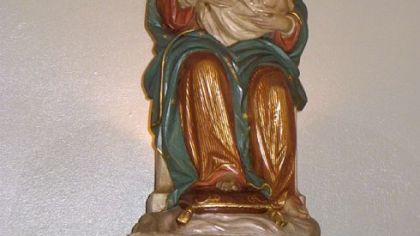
Its centerpiece is a replica of the Blessed Virgin nursing the infant Jesus. Many visitors --Catholics and non-Catholics -- ask for the blessing of motherhood.
"People who are pregnant come to pray for a safe delivery and healthy children," Mr. Johnson said, recalling that his own parents made a pilgrimage here from nearby Jacksonville when he was a child to pray for their new baby. And when he later moved to Maryland with his wife, he, too, journeyed back here to pray for his own children.
And more so now than ever before, couples who have been unsuccessful in having children come to pray.
"There's a great level of frustration and pain associated with infertility. I see more and more couples and more and more of their family members coming to pray," he said.
For many it gives them a time for prayer and reflection. During the visit, some may accept the fact that they have not been called to have their own child and they resolve to consider adoption.
One of Mr. Johnson's favorite stories involved a family he encountered one day walking through the grounds.
The Louisiana couple had visited only one time before, they told him, 35 years ago. He asked why it took them so long to return. "We had to raise our family," they said, explaining that they had nine children and 21 grandchildren.
"They had come here because they were unable to conceive. They both prayed to have children. But they came to the resolution that they should go home and adopt a child. That led to them adopting nine children."
There also are the many stories of shrine babies -- those whose prayers were answered. "We call them our own little miracles."
'Beacon of faith'
The grounds hold other fascinating artifacts. Dotted throughout the property are weathered tombstones, almost all from the 1800s.
An epidemic of yellow fever hit St. Augustine in 1821. Catholics felled by the disease were buried at the mission, away from the regular cemetery, because people were worried that the disease was contagious, even among the dead. Also included among these were six African American Union soldiers who had been part of the United States Colored Troops.
The most striking feature of the mission is the 208-foot-tall stainless steel cross that was erected in 1965 to mark the 400th anniversary of the city's founding. It stands as a sentinel over the mission and what Billy Graham called a "beacon of faith" for all who pass through the area.
Still on most days, this is a very quiet place and is easily overshadowed by the nearby Spanish fort, Castillo de San Marcos, which was constructed between 1672 and 1695, and other tourist sites in town.
"It's like an oasis of calm, tranquility and beauty in the middle of a tourist town," Mr. Johnson said about the mission and shrine. "A lot of people find it by accident."


Virginia Linn can be reached at vlinn@post-gazette.com or 412-263-1662. First Published November 22, 2009 5:00 AM
http://www.post-gazette.com/life/travel/2009/11/22/Was-first-Thanksgiving-in-St-Augustine-Fla/stories/200911220153